


Chronic obstructive pulmonary disease (COPD) is a leading cause of morbidity and mortality among older adults. As the population continues to age, primary care providers are facing greater responsibility in managing this complex, progressive condition. As the shift towards value-based care continues, strategies for COPD management are also shifting. Emerging pharmacological treatments, paired with a multidisciplinary approach, are helping improve outcomes for patients living with COPD.
A Collaborative Approach to COPD Care
Pharmacists are uniquely positioned to support the pharmacologic management of COPD. As medication experts, they ensure patients are prescribed the most appropriate therapy based upon based on disease severity, comorbid conditions, affordability, and the patient’s ability to correctly administer. Pharmacist involvement leads to better inhaler techniques, improved adherence, and early identification of adverse drug reactions.
A multidisciplinary approach to COPD management enables proactive, personalized care that prevents costly exacerbations. Pharmacists play a vital role by monitoring drug interactions, optimizing inhaler techniques, and providing smoking cessation services. Pharmacy technicians work alongside pharmacists to tackle medication access challenges, including assessing formulary coverage, identifying applicable copay cards, and facilitating enrollment in patient assistance programs. Care coordinators assist in tracking patient progress, reinforcing education, and addressing social determinants that may impact access or adherence. By working together, the entire team can reduce hospitalizations, improve symptom control, and deliver better care.
Innovations in Pharmacological Therapy
While traditional bronchodilators and inhaled corticosteroids remain the foundation of care, emerging treatments target inflammation, airflow obstruction, and the progression of the disease in novel ways. The 2025 GOLD (Global Initiative for Chronic Obstructive Lung Disease) report introduced key updates to COPD management strategies, including:
- New Therapies
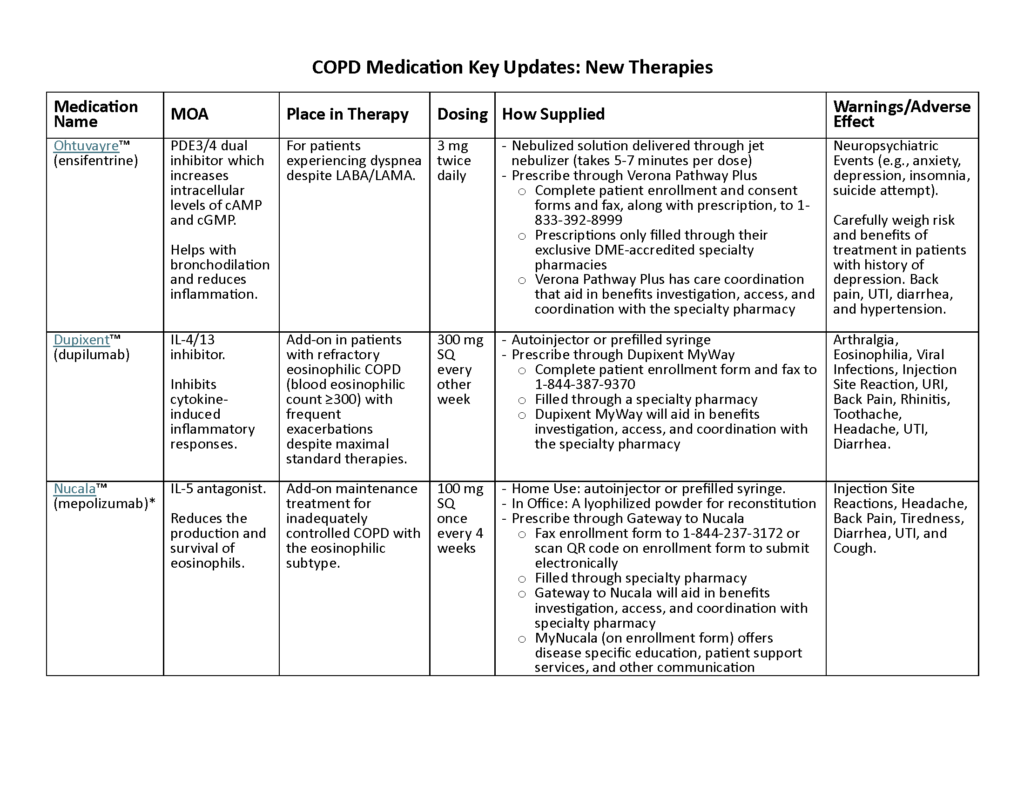
*Approved for COPD on May 22, 2025. Not listed in the 2025 GOLD guidelines due to timing of approval, but will likely appear in the 2026 version.
- Inhaler Options1 – The GOLD guidelines recommend starting COPD treatment based on how severe patient symptoms are and the number/severity of exacerbations in the last year. Treatments can be adjusted based on troubling symptoms or if exacerbations occur with regular medication.
| Treatment Group | mmRC Cat Score | Exacerbation History Per Year | Initial Strategy |
| A | 0-1 <10 | 0-1 Moderate No hospitalization | Bronchodilator |
| B | ≥ 2 ≥ 10 | 0-1 Moderate No hospitalization | LABA/LAMA |
| E | ≥ 2 Moderate OR ≥ 1 With Hospitalization | LABA/LAMA * if blood eos ≥ 300, consider LABA/LAMA/ICS |
- Follow-Up of Pharmacological Treatment1 – Check in with patients regularly to see if they are reaching their treatment goals and to identify any barriers to care. Watch for symptoms like shortness of breath or flare-ups, as these may signal that the treatment plan needs to be adjusted.
- Persistent Dyspnea
- Escalate to LABA/LAMA if on single agent
- Consider switching inhaler device or molescules
- Implement or escalate non-pharmacological treatments
- Consider the addition of Ensifentrine
- Investigate/treat other causes of dyspnea
- Exacerbating
- Escalate to LABA/LAMA if on single agent and blood eosinophil count < 300
- If blood eosinophil count ≥ 300, escalate to LABA/LAMA/ICS
- If blood eosinophil count ≥ 100 and already on LABA/LAMA, consider LABA/LAMA/ICS if continuing to exacerbate
- If blood eosinophil count ≥ 300 and chronic bronchitis, can add dupilumab
- If FEB1 < 50% and chronic bronchitis, consider roflumilast (monitor patient’s weight and neuropsychiatric effects)
- Azithromycin for frequent exacerbations despite optimal medication management. Use preferentially in former smokers.
- Persistent Dyspnea
As healthcare continues to prioritize outcomes over volume, a team-based approach to COPD is more important than ever. Providers should look to pharmacists as partners in achieving clinical goals, improving patient engagement, and lowering the total cost of care.
About the Author

Monica Wilson, PharmD, BCACP
Clinical Pharmacy Specialist at CHESS
REFERENCES
Global Initiative for Chronic Obstructive Lung Disease. Global strategy for the diagnosis, management, and prevention of chronic obstructive pulmonary disease: 2025 report. Bethesda: GOLD; 2025. http://www.goldcopd.org. Accessed July 9, 2025
Ohtuvayre™ (ensifentrine) inhalation suspension. Prescribing information. Verona Pharma, Inc.; 2024. Accessed July 9, 2025. https://ohtuvayrehcp.com/wp-content/uploads/sites/2/2024/11/Ohtuvayre-US-Prescribing-Information.pdf.
Dupixent™ (dupilumab) injection, for subcutaneous use. Prescribing information. Regeneron Pharmaceuticals, Inc; 2024. Accessed July 9, 2025. https://www.regeneron.com/downloads/dupixent_fpi.pdf
Nucala™ (mepolizumab) injection, for subcutaneous use. Prescribing Information. GlaxoSmithKline; 2023. Accessed July 9, 2025. https://www.accessdata.fda.gov/drugsatfda_docs/label/2023/125526Orig1s021,761122Orig1s011Corrected_lbl.pdf